
Malcolm Barrett
City of Dreams: Aqua - Matters of Time
- Fri 24 Apr 2026 9:00 – Sat 30 May 2026 17:00
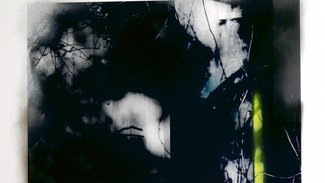
Barrett explores the idea of liminal spaces - transitional zones that exist between the past, the present, and an unknown future.
This exhibition focuses on two important kinds of space: water as a flowing line, represented by the Pix, and earth as an opening and closing line, represented by the Icknield Way. Both are vital to the history and identity of Letchworth Garden City.
The intervention started with ‘shaped walks’ from which drawings evolved through a series of prints. The work begins with a series of films about the Pix and the Icknield Way. Sadly, both landscapes have suffered severe damage. In some places they have disappeared entirely: the headwaters of the Pix have effectively been buried, while much of the Icknield Way has been lost to modern development.
City of Dreams: Aqua - Matters of Time has been produced by the Broadway Gallery through its Letchworth Open Bursaries 2025 programme.
Biography
Malcolm Barrett is a UK‑based visual artist whose work explores spatial intervention, time, and the histories embedded in environments through drawing, film, mixed media and site‑specific practice. Since the late 1960s his work has been shown in a wide range of contexts, from gallery exhibitions to architectural and public interventions, reflecting an ongoing commitment to reimagining how art activates and responds to space.
Selected presentations include Veilings – Name Him John (2021), a nocturnal digital intervention in a churchyard at St Nicholas, Arrington; Three Gardens (2019), a filmed intervention within a medieval ritual space at All Saints Church, Croydon; and Seven Stations for Shetland (2014), accompanied by talks and artist materials in St Magnus, Lerwick. Earlier work has been featured in digital and site‑specific projects such as Visions of Utopia (2005) at the William Morris Gallery, London, as well as architectural collaborations and interventions throughout the 1980s and 1990s.
Barrett’s practice is rooted in an enduring inquiry into how place, history and perceptual experience intersect; his films, works on paper and spatial interventions engage audiences with the layered narratives of sites both familiar and overlooked